
Asymmetric Value Extraction: Deconstructing User Exploitation, Human Data Harvesting, and the Myth of Creator Revenue Sharing within the Architecture of X
A Forensic Audit of Network-Level Capital Retention, Algorithmic Surplus Value (Mais-Valia), and Corporate Restructuring under the SpaceX-xAI Infrastructure

Executive Abstract: The Sovereign Data Prison
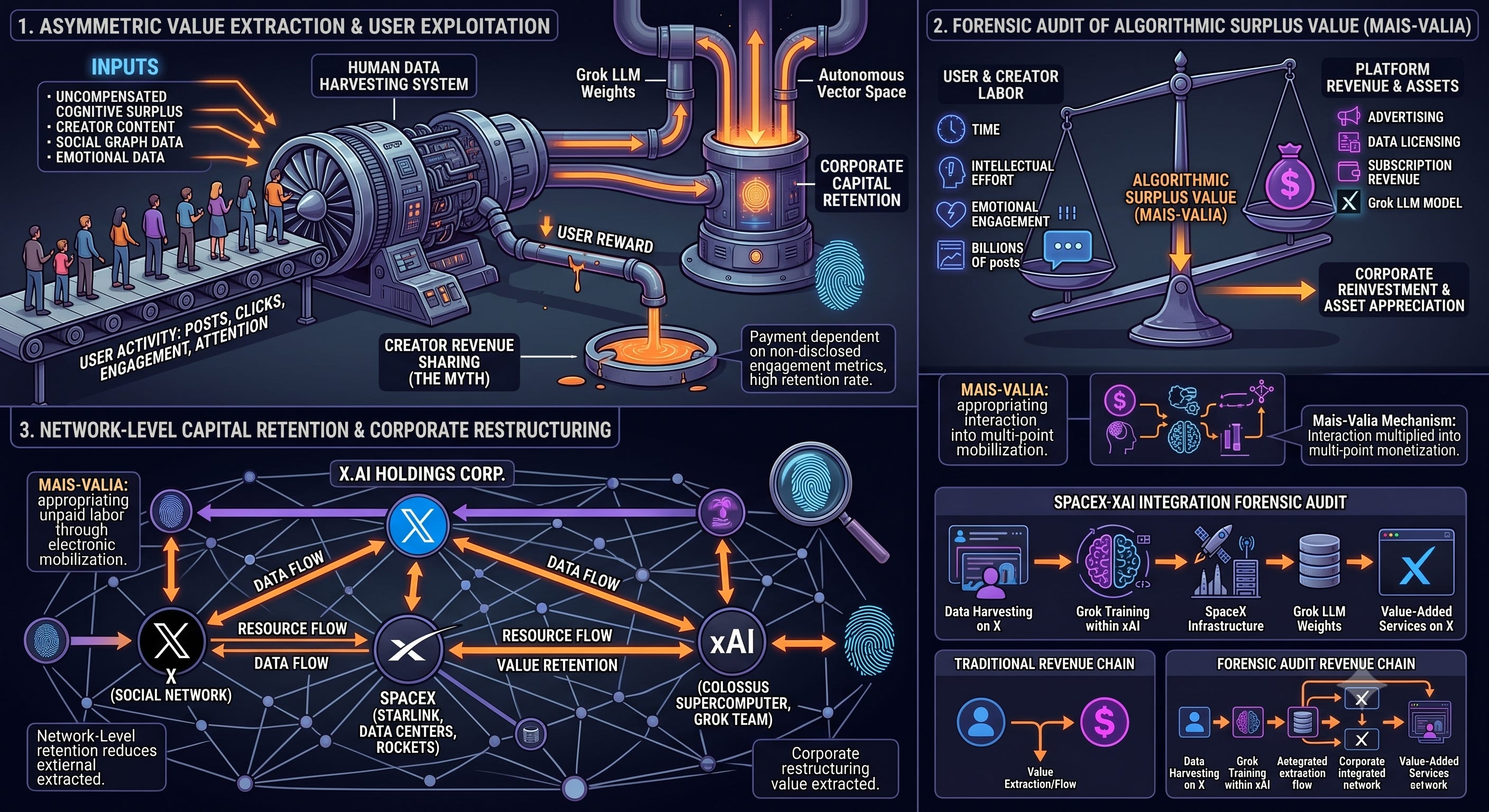
The contemporary operational layout of X represents an unprecedented evolution in platform-capitalism: the total mutation of a social media network into an extractive digital labor foundry. This architectural overhaul has systematically dismantled the legacy, ad-supported consumer interface to establish a highly optimized system of asymmetric data harvesting and corporate asset-stripping. Under the guise of the “Creator Economy,” X has weaponized tokenized revenue-sharing incentives to compel continuous, high-velocity user engagement. This engagement functions as unpaid digital labor, generating the primary raw material required to sustain the platform: a continuous, real-time database of human conversation.
This forensic audit exposes the hidden mechanics of this extraction network. It deconstructs the structural layout of a system that retains up to 99% of gross ad revenue, exploits geographic currency vulnerabilities, and enforces a closed-loop tech architecture. This architecture is designed to capture user-generated intellectual property and channel it, without compensation, into the machine learning pipelines of xAI and the consolidated balance sheets of SpaceX.
The Legacy Baseline: Constructing the Behavioral Data Target
A rigorous evaluation of X’s financial evolution requires establishing a baseline from its history as a publicly traded corporation. When Twitter, Inc. filed its Form S-1 with the SEC in 2013, it initiated a public offering intended to raise approximately $1 billion under the ticker TWTR. At that juncture, the company was fundamentally unprofitable, posting a net loss of $69 million for the first six months of 2013 on $253 million in total revenue. Of this revenue, $221 million was generated strictly from advertising. This structural dependence on advertising remained a defining feature of the platform’s unit economics throughout its public lifecycle, peaking in fiscal year 2021 when it generated $5.07 billion in total revenue.
During its public era, Twitter’s monetization was anchored in its native advertising products, primarily Promoted Ads. These units were integrated directly into timelines, search results, profiles, and conversational reply threads. Sold through real-time auctions on a pay-for-performance or pay-for-impression basis, these ad units forced marketers to optimize for specific behavioral outcomes, including tweet engagement, website conversions, application installs, or follower acquisition.
To augment this native inventory, the platform introduced Twitter Amplify, a program designed to monetize premium video content. Amplify allowed advertisers to place short video pre-rolls alongside premium video clips sourced from third-party publishing partners, such as sports leagues and news organizations.
The accounting treatment of these transactions is recorded in Twitter’s historical Form 10-K filings. Under US GAAP, because Twitter contracted directly with the advertiser for an integrated advertising service and maintained control of the third-party publisher content before its deployment, the platform recognized the associated advertising revenue on a gross basis. The revenue share paid to content publishers was subsequently recorded on the operating statement under cost of revenue.
A secondary, high-margin revenue stream was enterprise data licensing, often referred to as the conversational “firehose”. Under this model, Twitter granted data partners long-term, contractual access to its public historical and real-time database. These contracts were typically structured with fixed monthly fees over multi-year terms. Revenue recognition occurred straight-line over the license period for future data access, or at a single point in time for historical archives, depending on whether the arrangement transferred a right to use or a right to access the company’s intellectual property. This business model remained intact until the privatization of the company in October 2022.
The Infrastructure Transition: Restructuring X as a Raw Material Pipeline for xAI and SpaceX
Following Elon Musk’s $44 billion acquisition of Twitter in October 2022, the platform underwent a series of rapid operational changes. The transition from a public corporation to a private entity was accompanied by an immediate decline in advertising revenue. By fiscal year 2024, annual revenues had contracted to $2.50 billion, a decline of more than 50% relative to the platform’s public peak in 2021.
This revenue reduction was primarily driven by the exit of major brand advertisers. Brand safety concerns increased due to shifts in content moderation policies, with reports indicating that abuse, harassment, and hateful content accounted for more than 60% of total user reports on the platform in early 2024.
A financial recovery began to materialize in fiscal year 2025, with total revenue rising back to $2.90 billion, representing the first period of annual growth since privatization. This recovery was supported by the return of key advertisers following the 2024 US presidential election. Global advertising revenue for FY2025 reached $2.26 billion, a 16.5% year-on-year increase from 2024. However, this stabilization remained highly sensitive to broader political and cultural sentiments. Second-quarter 2025 advertising revenues dropped 2.2% compared to the first quarter, demonstrating that the recovery was not structurally secure.
To support its financial position and formalize its real purpose—the exploitation of user data—the platform was integrated into a larger corporate structure:
xAI Stock Acquisition (March 2025): xAI acquired X in an all-stock transaction. X was valued at $33 billion in equity ($45 billion when including its $12 billion in acquisition debt), while xAI was valued at $80 billion, creating a combined entity with a paper valuation of $113 billion. This transaction formalized the platform’s strategic role: converting X’s database of human conversation into the primary training dataset for xAI’s neural networks and its chatbot, Grok.
SpaceX Conglomerate Consolidation (February 2026): SpaceX completed an acquisition of the combined entity. This transaction integrated rocketry, satellite internet, artificial intelligence, and social media under a corporate structure valued at $1.25 trillion.
As a result of this restructuring, the first official, audited disclosure of X’s operating performance since its privatization was published in a SpaceX Form S-1 registration statement on May 20, 2026. This document revealed several key parameters of the consolidated business, mapped below against historical baselines:
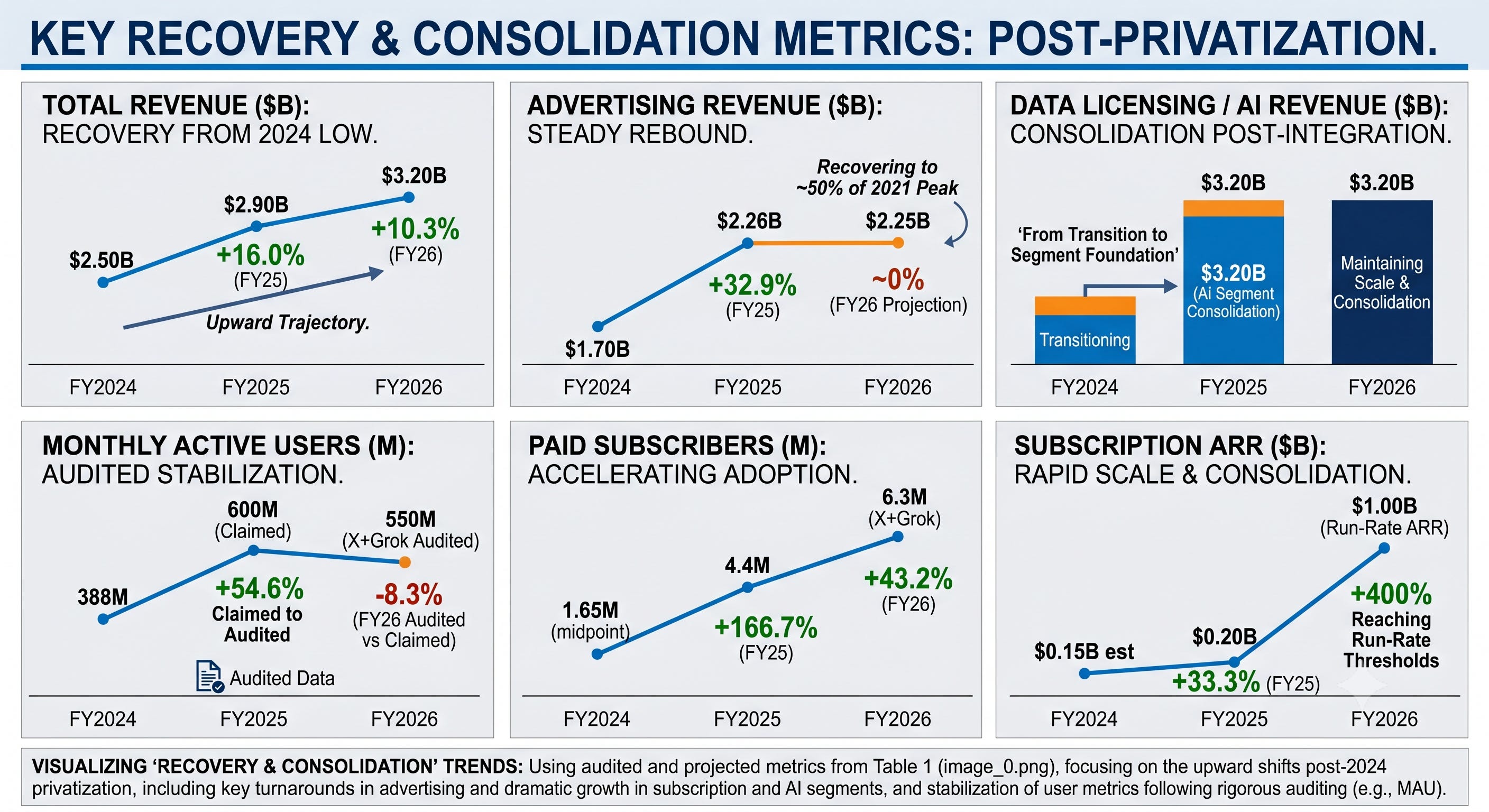
These audited disclosures indicate that X is no longer operated as a standalone, ad-supported business. Its primary financial role has been re-engineered to act as a data pipeline and infrastructure host for high-performance computing, with operating losses absorbed by the cash flows and capital access of SpaceX.
The Illusion of Partnership: Disaggregating the Formulaic Traps of Creator Revenue Sharing
To retain high-reach users and compete with alternative social networks, X introduced its Creator Ads Revenue Sharing program in July 2023. The program was designed to allow verified content creators to receive a share of the advertising revenue generated from ad impressions displayed in the reply threads of their posts. However, the program’s structural mechanics and eligibility rules have undergone several revisions to counter platform abuse and align with the parent organization’s financial goals.
At its inception, the program’s eligibility standards required an active subscription to X Blue (Premium) or Verified Organizations, a minimum of 500 followers, and at least 15 million organic impressions on cumulative posts over the preceding three months. On May 23, 2024, X revised these requirements, lowering the organic impression threshold to 5 million over the preceding 90 days to expand access, while introducing a mandatory identity verification protocol. Under this updated policy, all new creators must verify their accounts using government-issued photo identification, a rule that was applied to existing creators on July 1, 2024.
In October 2024, X implemented a structural shift in its payout calculations. The platform transitioned away from measuring raw ad impressions in reply threads, which had incentivized controversial posting behaviors designed to maximize replies. The updated formula allocates up to 25% of X Premium subscription revenue to a centralized creator pool. Creator payouts are calculated based on engagement metrics (including likes, replies, and watch time) generated exclusively by paid Premium and Premium+ subscribers. Engagement from unverified, free accounts is excluded from this calculation.
The formula weights engagement according to the subscriber’s tier. For example, interactions from a Premium+ subscriber (priced at $22 per month) are assigned a higher weight than those from a Basic subscriber (priced at $3 per month). Payouts are processed biweekly or monthly via Stripe once a creator accumulates at least $10.
Alongside these formulaic changes, X has tightened its policy enforcement mechanisms to remain brand-safe for advertisers. Accounts publishing content flagged for adult material, hateful conduct, violence, or misleading information are excluded from the ad-sharing system.
On March 3, 2026, X Product Manager Nikita Bier announced a targeted update to the Creator Revenue Sharing policy. Under this rule, any creator posting AI-generated video content related to armed conflict must apply a “Made with AI” disclosure label. Unlabeled publications of this nature trigger an immediate 90-day monetization suspension, while a second violation results in a permanent ban from the program.
Empirical Unit Economics: Quantifying the 99% Platform Retainment Rate and Global Labor Arbitrage
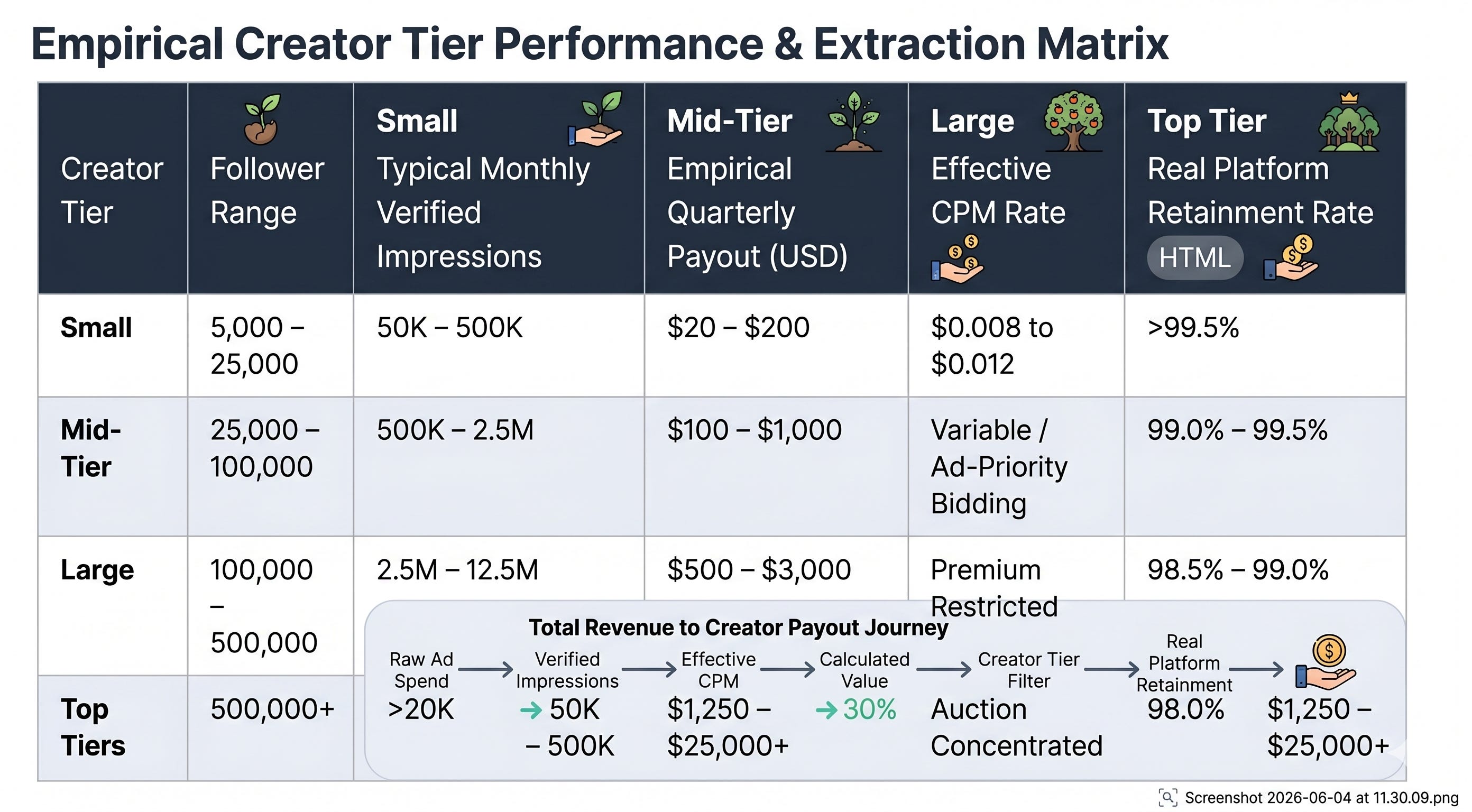
A significant gap exists between the marketing of X’s creator program and the empirical earnings reported by content creators. While some high-profile accounts have published screenshots of five-figure payouts, financial analysis indicates that these payouts are highly concentrated, with the effective payout rate per million impressions remaining low.
Unit Economics of Creator Impressions
X pays creators an effective rate of approximately $8.00 to $12.00 per 1 million impressions generated exclusively by verified Premium users. Impressions from non-verified accounts do not contribute to the calculation. Converting this to an effective Creator CPM (Cost Per Thousand impressions) yields a baseline mathematical range:
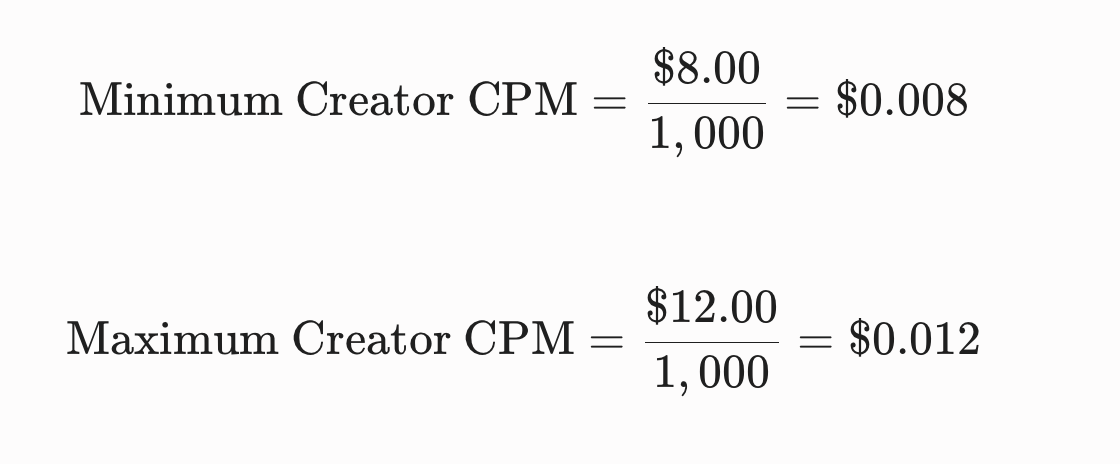
When compared to the average CPM of $4.00 to $8.00 paid by advertisers to place ads on X, these numbers show that the platform retains the vast majority of ad-generated revenue within conversational threads. Under standard terms, X offers a 97% revenue share on the first $50,000 in lifetime earnings, which drops to 90% after that threshold is crossed. However, because this percentage is applied only to the net revenue allocated after the platform’s internal CPM calculations, absolute payouts remain small for the majority of participants.
While the 97% net split is highly publicized, X is not transparent about the exact calculations used to determine what constitutes “net” ad revenue. Third-party industry estimates suggest that the platform-level revenue split of the ad space in reply threads is close to a 50% to 55% share (modeled after YouTube’s partner system).
The empirical reality, however, dictates that because payouts are only driven by engagements from verified Premium accounts, the actual payout yield for creators is compressed. When contrasted with the standard $5.00 CPM that brands pay to advertise on X, empirical data indicates that most creators take home less than 1% of the gross ad revenue generated by their threads, while X quietly retains 98% to 99% of the gross advertiser spend.
Geographic Exploitation and Regional Disparities
The economics of the program are highly unequal across different regions. Creators in developing markets, such as Nigeria, report significant challenges. Although many of these accounts generate high organic engagement, their financial returns are much lower than their counterparts in the US, UK, or Europe.
This disparity is driven by the geographic weighting of the advertising auction. Because advertisers pay much higher CPMs to target users in Tier-1 western markets, the ad revenue allocated to views from developing markets is compressed. A million views from unverified or geographically low-CPM users yields virtually zero revenue.
Additionally, because all payouts are distributed in USD through Stripe, international creators face currency exchange friction. Stripe frequently charges transaction and bank withdrawal fees of 2% to 5%. With rising subscription fees, such as the Premium tier cost increasing to 11,000 Nigerian Naira per month, many non-US creators operate at a net financial loss, leading to a decline in international participation.
The Computational “Surplus-Value”: Timeline Ingestion and Real-Time AI Training Loops
The traditional concept of surplus value states that the owner of capital extracts economic value from the uncompensated surplus labor of the working class. In X’s re-engineered architecture, this concept undergoes a digital transition, mutating into a framework of cognitive and computational “surplus-value”. Within this system, the traditional concept is adapted to describe how the platform extracts value from unpaid user labor.
Every alphanumeric characters typed, every video uploaded, every interaction logged, and the precise velocity of content propagation across the timeline are actively ingested to feed X’s internal AI ecosystem—specifically xAI’s neural network architectures and its chatbot, Grok.

The data flow pipeline operates as an automated feedback loop. Unlike competing frontier artificial intelligence models that must rely on periodic, static web scrapes or risk multi-million-dollar intellectual property litigation from legacy publishers, xAI exploits X as a living data foundry.
The user timeline functions as an infrastructure pipeline that converts human culture, breaking news, political discourse, and cognitive output into high-token-density training sets. This data is ingested directly by xAI’s computing clusters, including the Memphis supercluster infrastructure.
This model creates an acute value asymmetry. Under the Terms of Service enforced by X, users sign over extensive licensing rights to their content upon account creation. This architecture allows the corporate core to capture structural value through distinct mechanisms:
Synthetic Context Grounding: Grok derives its real-time performance edge by directly tapping the timeline’s information stream, transforming unpaid user analysis of breaking global events into proprietary, transactable data products.
Reinforcement Learning via Micro-Interactions: The physical layout of user interactions (likes, quotes, replies, bookmarks) acts as an active human-feedback network (RLHF). Users unknowingly correct model hallucinations, grade prose quality, and flag structural semantic inaccuracies without financial compensation.
Algorithmic Arbitrage: While X bills the public a baseline fee of $8 to $22 per month for verification or Grok access, the real value transaction is inverted. The user provides a continuous stream of data that helps lower the cost of model development, allowing xAI to expand its valuation to $80 billion.
This structure redefines platform exploitation. The user is no longer merely the product sold to an advertiser; the user’s cognitive labor is the raw engine infrastructure driving corporate enterprise value.
Regulatory Inversion: The Strategic Stripe Bypass and the Extraction of Direct User Capital
Given the low yield of the direct ad revenue sharing program, creators rely on alternative direct monetization features or migrate their monetization off-platform through indirect channels. Direct creator subscriptions allow users to charge $2.99, $4.99, or $9.99 per month for exclusive content. Under the platform’s original architecture, Apple and Google extracted a 30% commission on these transactions.
However, the regulatory landscape shifted following legal and regulatory actions, including the EU Digital Markets Act (DMA) and US anti-steering court rulings. In May 2025, the Northern District of California issued a contempt ruling against Apple. The court determined that Apple’s 27% commission on off-app purchases, combined with restrictive interface requirements, was anti-competitive. The ruling also referred the matter to the US Attorney for potential criminal contempt proceedings, specifically naming Vice President of Finance Alex Roman.
Following this ruling, Apple was forced to permit developers to add external payment links without restrictive pop-ups or commissions. Stripe subsequently released integration guides allowing platforms like X to send users to outside checkout pages, charging a standard fee of 2.9% plus $0.30 per transaction.
By bypassing the 30% App Store commission, creators and platforms retain a significantly larger portion of subscription revenue. This is reflected in SpaceX’s S-1 data, which reported 6.3 million active paid subscribers as of March 2026, driving subscription ARR close to $1 billion by February 2026. This transition bypasses historical app storefront bottlenecks, allowing the corporate core to capture user capital directly.
The Tri-Layer Capture Architecture
The distribution percentages for X’s creator monetization program are structured across three distinct layers, functioning as an integrated systemic trap designed to extract human labor while minimizing financial outflows from the corporate core:
Layer 1: The Public Platform Split (97% / 3% Facade): Officially, X offers a generous platform split, allowing creators to keep 97% of net monetization revenue up to a lifetime threshold of $50,000. Once this threshold is crossed, the platform’s cut increases to 10%. This metric functions as a promotional shield, hiding the fact that “net revenue” is calculated after the platform has already extracted the core financial value of the impression.
Layer 2: The Subscription Pool Allocation (The Behavioral Tether): Following the October 2024 pivot, X allocates up to 25% of Premium user subscription payments into a centralized pool. Payouts are calculated based on verified interactions generated exclusively by paid subscribers. This system forces creators to police their own content, incentivizing them to post high-friction, engagement-heavy content that targets other paid subscribers, while excluding the organic reach of unverified users.
Layer 3: The Algorithmic Ingestion Sink (Total Asset Appropriation): The base layer of the system operates completely outside the financial ledger. While the creator chases nominal payouts driven by Premium account metrics, 100% of the underlying structural intellectual property is swallowed by the backend pipeline. The platform strips the conversational timeline of its context, converting the text and user video data into training assets for xAI. The user pays a monthly subscription fee for the visibility required to participate in an environment that extracts their labor.
Conclusion: Capital Market Determinations, Sovereign Data Asymmetry, and the New Surplus Value
The quantitative data presented in SpaceX’s May 2026 S-1 filing, coupled with the systemic shifts in X’s monetization formulas, confirms a predatory strategic reality: X has successfully institutionalized human engagement as an unpaid extraction commodity. The platform is no longer operated as a standalone, consumer-facing social network. Its primary financial and operational role has been re-engineered to function as a data pipeline and infrastructure host for high-performance computing, with operating losses absorbed by the cash flows and capital access of SpaceX.
The integration of the platform’s timeline as a real-time ingestion loop for xAI establishes an advanced form of computational surplus-value. By forcing creators to buy Premium and Premium+ subscriptions to remain eligible for payouts that yield an effective CPM of $0.008, X has constructed a circular economy where users pay the platform for the right to generate the very data the platform extracts.
The platform’s true economic output is no longer recorded in advertiser click-through metrics or gross subscription yields; it is recorded in the model weight optimization, neural vector alignments, and structural algorithmic sovereignty achieved by xAI and SpaceX. Ultimately, the user base is not the customer, nor are they partners in a creator economy; they are the raw, uncompensated behavioral real estate anchoring a $1.75 trillion aerospace and artificial intelligence conglomerate.