
Money Laundering - Back to the Basic [ML02]
From ghost transfers to offshore trusts: A technical breakdown of the three stages criminals use to hide billions in plain sight.

MONEY LAUNDERiNG, FRAUD & CORRUPTiON 101
Most people — even many professionals — still don’t understand what money laundering, fraud, and corruption actually are.
They routinely confuse simple accounting errors with deliberate criminal schemes and completely miss how corruption, fraud, and laundering form a deadly, self-reinforcing triad.
Criminals count on this exact ignorance to operate undetected.
To protect the financial system and society, we must stop relying on headlines and master the real distinctions, technical mechanics, precise terminology, and full interconnected picture of Fraud, Corruption, and Anti-Money Laundering (AML).
CORE DiSTiNCTiONS – DON’T CONFUSE THE PiECES
Fraud is the acquisition phase: the deliberate deception to obtain money, assets, or advantages illegally (e.g., embezzlement, invoice fraud, Ponzi schemes, or procurement kickbacks).
Money Laundering is the processing phase: taking “dirty” proceeds from crime and disguising their illegal origin so they appear legitimate. Laundering cannot exist without a predicate offense (the original crime that generated the funds).
Corruption is often the root enabler: abuse of entrusted power for private gain (bribery, extortion, nepotism, embezzlement of public funds). Corruption frequently triggers fraud and is almost always followed by laundering to hide the proceeds.
Errors vs. Deviations
Errors: Unintentional mistakes (typo in a spreadsheet, misapplication of accounting rules).
Deviations: Deliberate redirection of funds from their intended purpose. A deviation becomes fraud when intent to deceive is proven; it becomes laundering only when efforts are made to conceal the source.
Predicate Offense: The underlying crime (drug trafficking, fraud, corruption, human trafficking, tax evasion, sanctions evasion, etc.). Without a predicate offense, there is no “dirty” money to launder.
THE “LAYERiNG” FOG – THE PART ALMOST NOBODY GETS
Layering is the criminal’s real weapon: a deliberate avalanche of transactions, jurisdictions, and entities designed to destroy any audit trail. This is why most schemes stay hidden.
Common layering tactics today:
Shell companies and offshore trusts
Trade-Based Money Laundering (over/under-invoicing)
Crypto mixers and privacy coins
Loan-back schemes
Rapid account hopping across borders
FOOTBALL: THE CRiMiNALS’ FAAVORiTE LAYERiNG MACHiNE
As noted by the EU’s AMLD6 and the UK’s 2025 National Risk Assessment, Football is pure gold for layering. Hundreds of billions move every year through player transfers, agent fees, sponsorships, and club ownership — all justified by “market value” that no one can objectively verify in real time.
Criminals buy clubs via offshore shells and multi-club networks, then layer dirty money by wildly inflating transfer fees (the excess gets kicked back through agents or image-rights vehicles in tax havens), routing fake sponsorship deals from controlled entities, or shuffling funds between their own clubs in internal “sales.”
Real-world execution:
The 2015 FIFA scandal layered over $150 million in bribes through marketing rights and offshore accounts across continents.
Spanish officials used “ghost player” transfers to move and clean €10 million+ into luxury assets.
Undercover investigations exposed how criminals buy English clubs by hiding identities behind offshore trusts and fake due-diligence reports.
This is exactly why the EU forced professional football clubs and agents into full AML obligations, and why the UK’s 2025 National Risk Assessment named football clubs and agents as emerging high-risk sectors for laundering. The football became the perfect fog machine — until regulators finally turned the lights on.
THE THREE OFFiCiAL STAGES OF MONEY LAUNDERiNG AND SOME THEORETiCAL EXEMPLES
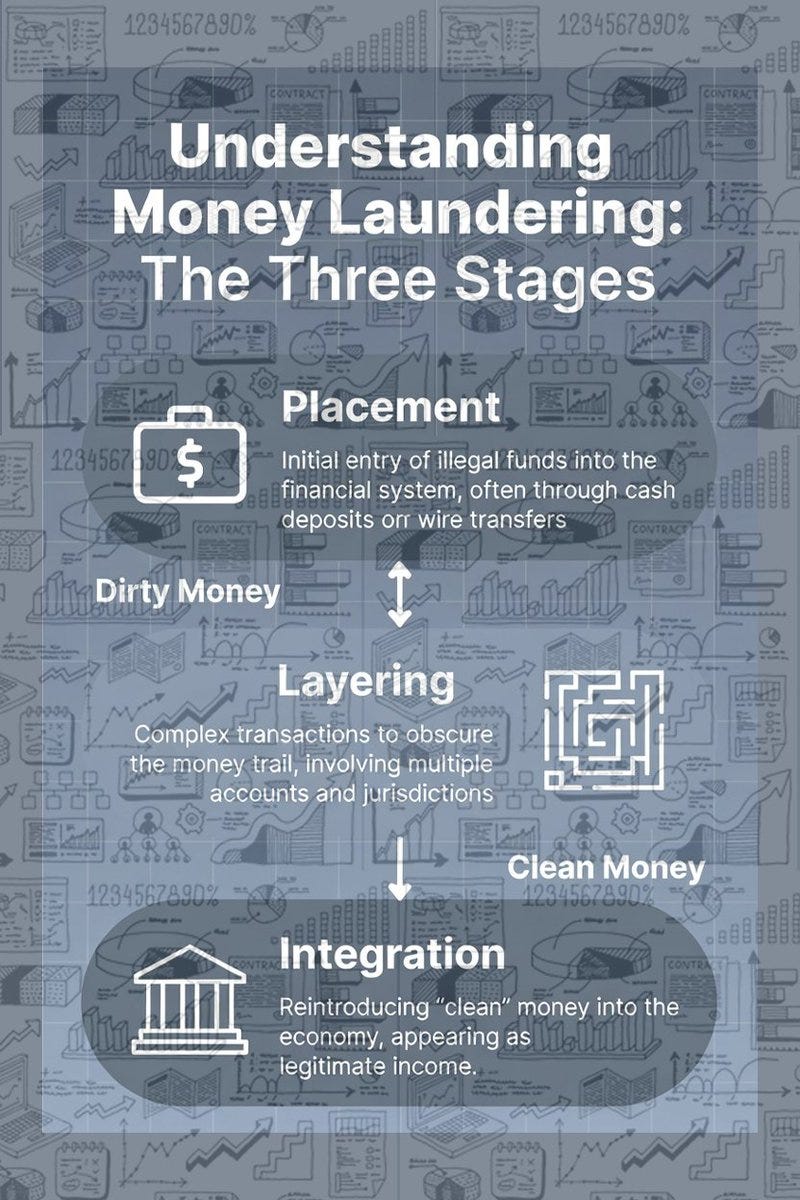
Stage 1: Placement (Getting the Dirty Money In) The riskiest stage — introducing illicit cash or assets into the legitimate financial system. Classic technique: Smurfing/Structuring (dozens of runners depositing just under reporting thresholds). Football example:Criminals place dirty cash by having multiple associates buy season tickets, VIP hospitality packages, club merchandise, and make small cash “donations” to youth academies. These payments are recorded as normal club revenue, allowing large sums of illicit cash to enter the banking system in small, unsuspicious amounts.
Stage 2: Layering (Creating the Fog) The heart of the crime. Multiple transactions are layered to sever the link to the predicate offense. Football example:
Money from a match-fixing bribe is wired to a shell company in the British Virgin Islands, set up as a fake football agent.
The funds are then “loaned” to a Luxembourg company for third-party ownership of player economic rights.
Next, the money is converted into image-rights contracts or fan-token investments.
Finally, it is routed through over-invoiced player transfers or stadium equipment deals between clubs.
Stage 3: Integration (Spending the “Clean” Money) The funds re-enter the economy as apparently legitimate profits and can now be freely spent. Football example: A corrupt club owner or agent uses the laundered money (disguised as legitimate profits from player trading, agent commissions, or a football consulting firm) to buy luxury real estate, yachts, private jets, and high-value football memorabilia. These assets can later be sold or used as collateral for clean bank loans.
SOME RED FLAGS OF MONEY LAUNDERiNG iN FOOTBALL
Stage 1 – Placement Red Flags:
Large amounts of cash used to purchase season tickets, luxury boxes, or merchandise without logical explanation
Multiple unrelated people making repeated small cash payments to the club’s academy or charity programs
Sudden sponsorship deals from unknown companies in high-risk jurisdictions
Stage 2 – Layering Red Flags:
Player transfer fees that are significantly higher or lower than the player’s actual market value
Involvement of an unusually high number of agents and intermediaries in one transfer
Player economic rights or image rights held by offshore companies with no real activity
Over-invoiced amounts for scouting reports, consulting services, or club infrastructure projects
Frequent back-and-forth loans between clubs and foreign shell companies
Stage 3 – Integration Red Flags:
Club owners, directors, or agents acquiring expensive properties, cars, or yachts far beyond their official income
A club generating high revenues while achieving consistently poor sporting results
Rapid buying and selling of players generating suspicious profits
Club funds being used to cover personal expenses of owners or their families
MODERN CHALLENGES iN FOOTBALL MONEY LAUNDERiNG
Cryptocurrencies, player NFTs, club fan tokens, decentralized finance (DeFi), and AI-generated deepfake documents have added powerful new layers of complexity — and risk — to money laundering in football. Criminals now exploit these technologies through anonymous crypto payments for player transfers and agent commissions, overvalued NFT sales tied to player image rights or digital memorabilia, DeFi platforms disguised as investments in fan tokens or player economic rights, and deepfake contracts, passports or scouting videos to support fake ownership structures.
However, even with these modern tools, the core principles (Placement → Layering → Integration) remain identical.
Mastering these fundamentals isn’t just for compliance officers — it’s essential for anyone who wants to understand how financial crime actually works and why strong AML controls, transparency, and ethical governance matter. The more people can distinguish error from deviation, fraud from laundering, and corruption from legitimate business, the harder it becomes for criminals to hide in plain sight.
Knowledge is the first line of defense!
However you found your way here—via the algorithm, a shared link, or a search result—thank you for reading.
I am dedicated to providing an independent perspective on the business side of the “beautiful game,” covering everything from finance to regulation. If you find this insight valuable, please consider supporting my work:
This Substack is reader-supported. To receive new posts and support my work, consider becoming a free or paid subscriber.
Thanks for backing independent analysis!
This work is licensed under CC-BY-SA 4.0
LEGAL DiSCLAiMER
1. Educational & Academic Intent: This series is published strictly for educational, research, and journalistic purposes. The analysis provided is based on public-domain reports (FATF, OECD, UNODC) and academic theory. It does not constitute legal, financial, or anti-money laundering (AML) advice.
2. Non-Accusatory Framework: Any “Red Flags,” “Case Studies,” or “Vulnerabilities” discussed are theoretical or systemic in nature. Unless explicitly stated otherwise as a matter of public judicial record (i.e., a final court conviction), the mention of specific industries, entities, or regions does not imply the existence of criminal activity or “Actual Malice.”
3. No Investigative Mandate: The author is acting as a private analyst and commentator. This work is not a criminal denunciation (notícia-crime), nor is it an attempt to bypass the exclusive investigative jurisdiction of state authorities.
4. Opinions & Fair Comment: Views expressed regarding the efficacy of global regulations (such as FATF standards) are the author’s own and fall under the protections of “Fair Comment” and “Public Interest” regarding matters of global financial integrity.
5. Third-Party Links: Any references to external news reports or controversies (e.g., “Live Sorte”) are provided for historical context and represent the reporting of those respective outlets, not original allegations by this author.