
Seven Glaring Errors in Anthropic’s "Loving Grace" AI Myth
How tech billionaires use apocalyptic utopianism to hide astronomical cash burns, flawed economics, and the biological limits of silicon.

In recent years, the elite architects of Silicon Valley have seamlessly transitioned from software executives into modern-day prophets. Chief among them is Anthropic CEO Dario Amodei, whose sweeping essay Machines of Loving Grace envisions a near-future where artificial intelligence operates as a “country of geniuses in a data center.”1 Amodei’s gospel rests on two foundational dogmas: first, that machines will inevitably become superior to humans in every conceivable respect; and second, that they will consequently replace human beings in the labor market on a massive, structural scale.
It is a terrifying, awe-inspiring narrative. It is also remarkably hollow.
When we deconstruct this Silicon Valley mantra, the facade crumbles. What remains is a series of fundamental misunderstandings about biology, macroeconomics, and the very nature of human intelligence. Here is an expanded guide to spotting the seven glaring errors in the tech billionaires’ favorite apocalyptic utopia.
1. The Fallacy of Surpassing the Creator
The assertion that AI will comprehensively outsmart its creators relies on a catastrophic philosophical and technical error. Generative AI models are, at their core, sophisticated statistical engines. As cognitive scientist Gary Marcus and computational linguist Emily M. Bender have extensively documented, Large Language Models (LLMs) are essentially “stochastic parrots”—they map statistical probabilities between words based on massive sets of training data; they do not possess sentient comprehension, causal reasoning, or a model of the physical world.23
To assume that a statistical parrot will achieve a magical ontological leap over the human consciousness that built it ignores Ada Lovelace’s famous 19th-century objection: a computer can only do whatever we know how to order it to perform. Predicting the next word based on a regurgitation of human genius is not the same as possessing genius. Intelligence is not merely data processing; it is the ability to navigate novelty, apply common sense, and understand meaning—traits that remain fundamentally absent in silicon.
Ultimately, there is a profound irony in these prophetic claims. By peddling such reductive philosophical nonsense, the Anthropic CEO demonstrates a highly mechanical, impoverished view of intelligence that falls staggeringly short of true human brilliance. If a machine is fundamentally constrained by the paradigm and architecture designed by its creator, then Amodei’s AI is destined to hit a hard cognitive ceiling. It will never supersede humanity's greatest minds because it will inevitably reflect the intellectual limits of a tech executive who mistook a very fast calculator for a conscious being—ensuring his "god-like" machine remains exactly as fundamentally limited as he is.
2. The Vast Neurological Gap
Amodei’s vision casually glosses over the staggering biological chasm between the human brain and the most powerful supercomputers. The human brain operates on approximately 20 watts of power—roughly the energy required to illuminate a dim LED lightbulb—while processing complex, multimodal, and abstract realities in real-time.4 It is capable of lifelong learning without forgetting old information (neuroplasticity) and requires only a few examples to grasp a new concept.
Conversely, training and running an AI model requires gigawatts of electricity, specialized cooling towers, and data centers the size of small towns. To equate algorithmic, brute-force data ingestion with the hyper-efficient, highly adaptable, and profoundly complex biological capacity of the human mind is a category mistake of the highest order. Machines are not “outsmarting” us; they are just burning through small nations’ worth of electricity to approximate our syntax.
3. The “RoboCop Complex”
When discussing the automated replacement of human labor, AI evangelists consistently ignore what we might call the “RoboCop Complex.” In Paul Verhoeven’s 1987 sci-fi classic, the fully mechanized ED-209 enforcement droid is a catastrophic failure because it strictly executes code without human empathy, moral intuition, or contextual awareness.5 The cyborg Murphy only succeeds because he retains his human soul, lived values, and ethical judgment.
In the real world, human labor is rarely just about executing a mechanical or textual task. A doctor’s diagnosis, a lawyer’s negotiation, or a manager’s strategic pivot involves an irreplaceable matrix of soft skills, emotional intelligence, and ethical nuance. Furthermore, human decisions carry “skin in the game.”6 You cannot algorithmically replicate the moral and social weight of a decision made by a human who must physically, legally, and socially live with the consequences.
4. The Socio-Economic Paradox of Mass Unemployment
If we accept the techno-determinist assertion that massive job displacement is both inevitable and structural, we immediately crash into a fatal macroeconomic paradox. If machines replace humans on a massive scale and hollow out the working and middle classes, who exactly is going to buy the goods, services, and software subscriptions that sustain the economy?
Henry Ford famously understood that he had to pay his assembly-line workers enough so they could actually afford to purchase his Model T cars.7 An AI agent does not buy groceries, it does not pay a mortgage, it does not take vacations, and it certainly does not generate consumer demand. Widespread labor displacement would trigger a catastrophic crisis of underconsumption, destroying the very market required to sustain the tech industry’s astronomical profits.
5. The Illusion of Economic Viability
Behind the curtain of machine supremacy lies an abysmal financial reality: generative AI is currently a spectacularly bad business for the companies deploying it. The models are immensely expensive to build, costly to run (inference costs), and offer highly questionable returns on investment (ROI) for enterprises.
As Jim Covello, Head of Global Equity Research at Goldman Sachs, bluntly pointed out, the foundational economics of AI are highly suspect. He noted that while chipmakers (like Nvidia) are getting rich selling the “picks and shovels,” the companies actually implementing the technology are largely losing money, driven by corporate FOMO (Fear Of Missing Out) rather than actual productivity gains.8 “At some point,” Covello noted, “you’ve got to make money.” Replacing a $15-an-hour customer service rep with a multi-million-dollar AI infrastructure is not an economic revolution; it is a balance sheet disaster.
6. The Trillion-Dollar Math Problem
To understand the sheer scale of this lack of viability, one only needs to look at the venture capital math. Sequoia Capital partner David Cahn previously warned of a massive AI revenue gap—an analysis showing that the AI industry must generate trillions in end-user revenue just to break even on the projected infrastructure and data center expenditures required to build these “machines of loving grace.”9
For context, the projected revenues of industry darlings like OpenAI and Anthropic represent a microscopic fraction of this required capital. The math simply does not work. The tech industry is currently cannibalizing itself, building out unprecedented physical infrastructure for a promised utopia that the market is neither willing nor able to pay for at scale.
7. The Ultimate Smokescreen
This brings us to the seventh and final error—which exposes the true utility of this entire absurd narrative. Why do highly educated, supposedly rational executives actively push the myth of an omnipotent, job-destroying AI?
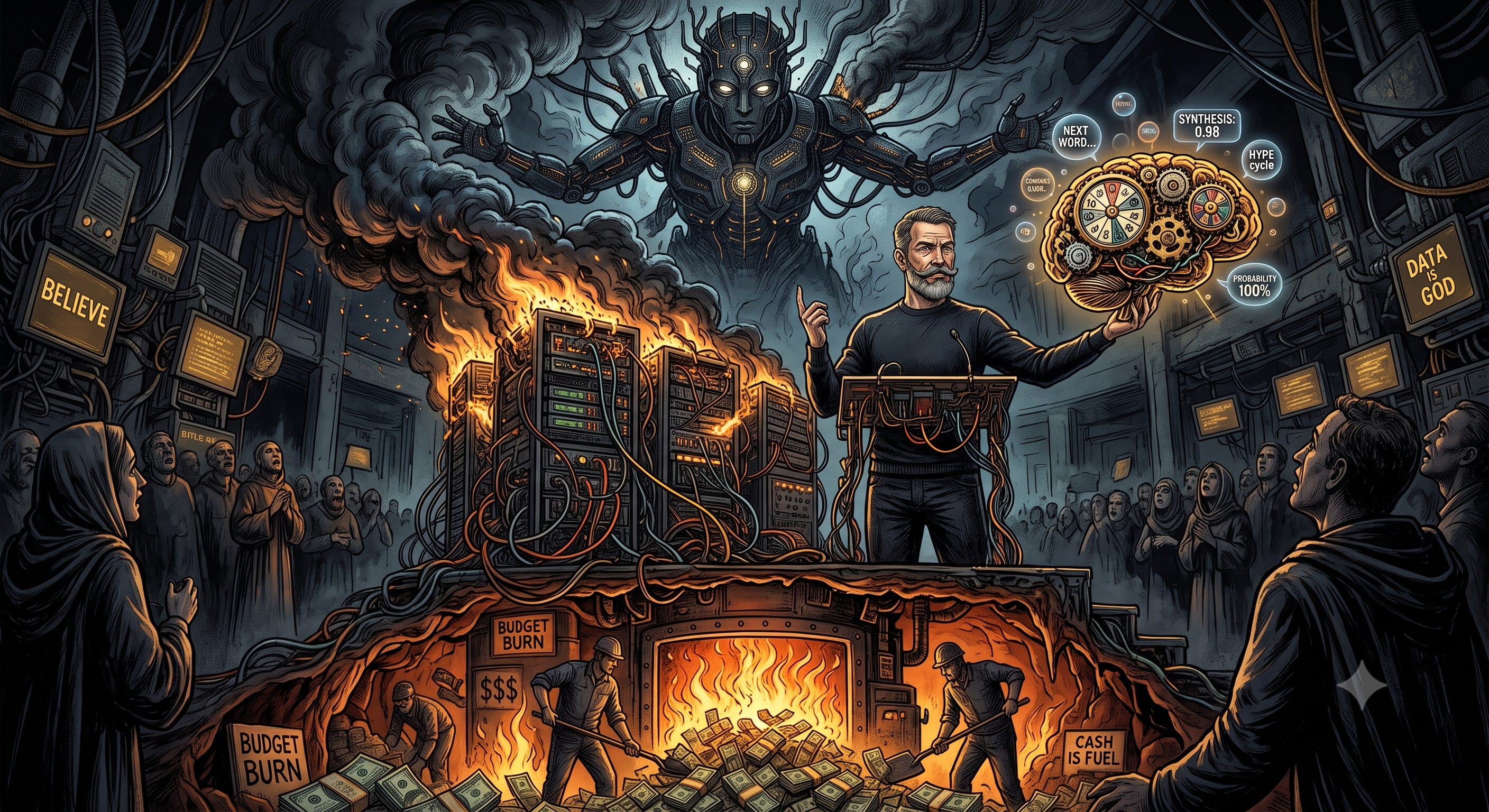
Because it serves as the ultimate smokescreen. By keeping the public, regulators, and investors fixated on sci-fi prophecies and apocalyptic labor transformations, they successfully distract from a critical analysis of AI’s glaring technical limitations. More importantly, it distracts from the billions of dollars these executives burn through every single quarter despite a glaring lack of a sustainable business model.
If Amodei and his peers admit they have merely built a highly impressive, wildly over-expensive text-completion tool, their astronomical valuations collapse to the level of standard software companies. To keep the investment capital flowing, they must masquerade as the architects of a new epoch. They must frame massive cash burns not as corporate losses, but as the inevitable cost of “building God."10
Conclusion
The narrative surrounding Anthropic, OpenAI, and the broader generative AI ecosystem is less a scientific roadmap than a secular theology designed to protect a financial bubble. By deconstructing the “Seven Errors,” it becomes clear that machines are not on the verge of biological supremacy, nor is an automated economic utopia (or dystopia) imminent.
Instead, we are witnessing a massive misallocation of capital, driven by philosophical hubris and economic desperation. The true danger of artificial intelligence is not that it will wake up and take our jobs. The danger is that the tech elite will burn down the very foundations of the global economy—and the electrical grid—trying to build a machine that was never possible in the first place, leaving the rest of us to clean up the wreckage when the smokescreen finally clears.
Epilogue: The Universal Basic Pacification and the Muskian Delusion
If the Anthropic smokescreen is built on philosophical hubris, the corollary myth—championed most vocally by Elon Musk—is built on a foundation of infantile political economy. Whenever the glaring socioeconomic holes of the AI revolution are exposed, Musk and his sycophants deploy a convenient fallback narrative: the impending “agentic and robotic era” will generate such unprecedented abundance that all labor will become voluntary, and humanity will bask in “exorbitant richness” sustained by a Universal Basic Income (UBI).
To accept this premise requires a near-total lobotomization of historical, economic, and thermodynamic reality.
First, the promise of “infinite abundance” ignores the hard limits of physics. AI models and robotic labor forces do not exist in the ether; they are bound by the brutal constraints of terrestrial reality. They require gigawatts of energy, massive water consumption for cooling, and the relentless extraction of rare-earth metals. Wealth and physical production cannot be magically infinite on a planet with finite physical resources, no matter how clever the code is.
But the most violently absurd element of Musk’s prophecy is its socioeconomic narrative trap. It demands we believe that the same techno-oligarchs who actively crush unionization, evade taxation, and fight against living wages will suddenly undergo an unprecedented historical mutation into benevolent deities. It assumes they will seamlessly socialize the profits of an entirely privatized, automated economy. Why would a corporate monopoly—having finally achieved total automation and severed its reliance on human labor—voluntarily distribute “exorbitant richness” to a now-obsolete populace?
Historically, when a ruling class no longer requires a segment of the population for labor or warfare, they do not lavish them with utopian wealth; they abandon, exploit, or enclose them. In a capitalist framework, whoever owns the means of automated production owns the future.
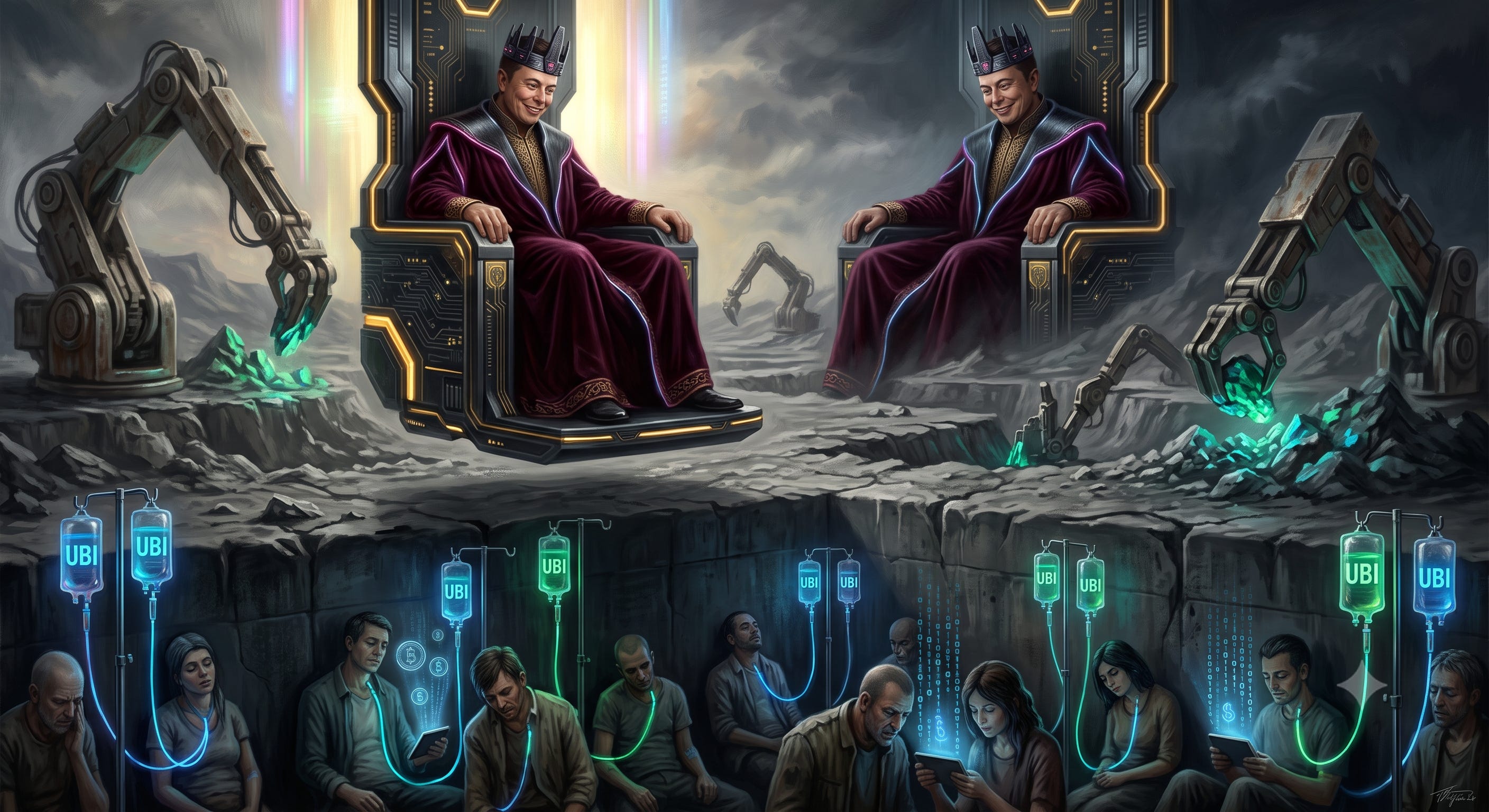
Musk’s version of UBI is not a roadmap to shared prosperity; it is a weapon of mass pacification. It is a psychological trap designed to sedate the working and middle classes while their structural power is dismantled. The implicit bargain is deeply insidious: Do not resist your displacement, do not demand regulatory oversight, and do not question our monopoly over the future—just wait quietly for your utopian welfare check.11
If ever implemented by this class of executives, UBI would not be a ticket to a life of luxury and leisure. It would be a digital subsistence ration—a minimum-viable life-support drip calibrated to provide just enough liquidity to keep the masses docile and purchasing the algorithmic slop the billionaires are selling. Musk’s narrative is the ultimate con: an attempt to dress up the architecture of high-tech neo-feudalism as a sci-fi utopia, peddled by a man who fundamentally misunderstands both human nature and the very economic system he exploited to get rich.
Dario Amodei, “Machines of Loving Grace: How AI Could Transform the World for the Better” (Anthropic, October 2024).
Emily M. Bender, Timnit Gebru, Angelina McMillan-Major, and Shmargaret Shmitchell, “On the Dangers of Stochastic Parrots: Can Language Models Be Too Big?” Proceedings of the 2021 ACM Conference on Fairness, Accountability, and Transparency (March 2021).
Gary Marcus and Ernest Davis, Rebooting AI: Building Artificial Intelligence We Can Trust (Pantheon Books, 2019). Marcus consistently highlights the difference between statistical matching and true causal reasoning.
David Eagleman, The Brain: The Story of You (Pantheon Books, 2015). A standard neurobiological consensus places the human brain’s energy consumption at roughly 20 watts.
RoboCop, directed by Paul Verhoeven (Orion Pictures, 1987). The film serves as a lasting cinematic critique of automating lethal and ethical judgment.
Nassim Nicholas Taleb, Skin in the Game: Hidden Asymmetries in Daily Life (Random House, 2018). Taleb argues that systems fail when decision-makers (or algorithms) do not bear the consequences of their actions.
See historical analyses of “Fordism.” In 1914, Henry Ford instituted the $5 workday, explicitly tying the wage of the worker to the purchasing power required to sustain macroeconomic demand.
Jim Covello, “Gen AI: Too Much Spend, Too Little Benefit?” Goldman Sachs Global Equity Research (June 2024). Covello highlighted that the estimated $1 trillion in capex spending on AI infrastructure lacked a corresponding roadmap for enterprise profitability.
David Cahn, “AI’s $600B Question” (Sequoia Capital, 2024). Cahn’s math, which has only compounded as capital expenditures have accelerated into 2026, demonstrates the massive disparity between hardware spending and actual software revenue.
Tech journalist Kara Swisher and other Silicon Valley critics frequently use terms like “building God” to describe the messianic, cult-like rhetoric employed by AGI (Artificial General Intelligence) evangelists to justify infinite venture capital funding.
See Yanis Varoufakis, Technofeudalism: What Killed Capitalism (Bodley Head, 2023) and Douglas Rushkoff, Survival of the Richest: Escape Fantasies of the Tech Billionaires (W.W. Norton, 2022). Political economists and tech critics frequently warn that Silicon Valley’s iteration of Universal Basic Income functions as a “neoliberal Trojan horse.” Rather than democratizing wealth, it is designed as a pacification mechanism to neutralize class consciousness, dismantle traditional labor rights, and replace the democratic welfare state with a system of absolute dependence on platform monopolies.