
The Hypocritical Bludgeon
Deconstructing Section 301 Forced-Labor Tariffs: From Populist Propaganda to Strategic Asset Containment

Executive Synthesis)
The Target: The Office of the United States Trade Representative (USTR) Section 301 additional ad valorem tariff schedule proposed on June 2, 2026.
The Forensic Vulnerability: The tariff schedule functions primarily as a highly visible political theater instrument rather than an operational trade-remediation mechanism. The architecture relies on symbolic penalties while implementing selective, hypocritical waivers on critical inputs that the domestic economy cannot survive without (Chinese rare earths, Indian APIs, Brazilian agricultural assets).
The Predicted Practical Effects: Minimal long-term realignment of upstream foreign manufacturing assets. Importers face a projected 50–100% historical pass-through cost incidence on finished components, while corporate monopolies are predicted to exploit the protectionist narrative to artificially expand retail margins (”Greedflation”).
The Prescriptive Next Step: Shift the enforcement paradigm away from porous macro-tariffs toward an algorithmic, asset-level containment model. Actors are advised to establish smart distributed ledgers and coordinate unilateral financial node restrictions to force targeted behavior modification without distorting general commerce.
DISCLAIMER
This dossier constitutes an adversarial stress-test simulation and policy deconstruction based on synthesized trade telemetry. It does not constitute fiduciary, legal, financial, or investment advice. Forward-looking projections, prescriptive next steps, and macroeconomic pass-through models are stochastic simulations and predictive suggestions subject to extreme macroscopic volatility, sovereign countermoves.

Sovereign Coercion and the Architecture of Trade Blackmail
The proposed 12.5% additional ad valorem tariff schedule introduced by the USTR on June 2, 2026, functions primarily as an instrument of sovereign economic blackmail disguised as global labor advocacy. By assigning the operational mechanics of Section 301 of the Trade Act of 1974 to a high-moral-valence justification, the framework attempts to build political legitimacy. However, its architecture reveals that it behaves as an asymmetric extortion tool designed to alter bilateral bargaining postures.
The flat percentage increments and two-tier country classification do not map to granular, risk-based on-chain labor audits. Instead, they apply generalized fiscal friction to target countries like China, India, and Brazil. This deployment mirrors the 2025 tariff realignments, where broad protectionist threats were weaponized to extract concessions in entirely unrelated parallel negotiations. The moral predicate operates as portable political cover for traditional protectionist statecraft.
Structural Asymmetry and Material Commodity Deficits
A deep audit of the USTR exemption list exposes a clear structural mismatch: the policy purposefully immunizes sectors where the domestic market faces inelastic supply constraints. This selective enforcement pattern creates a highly compromised architecture.
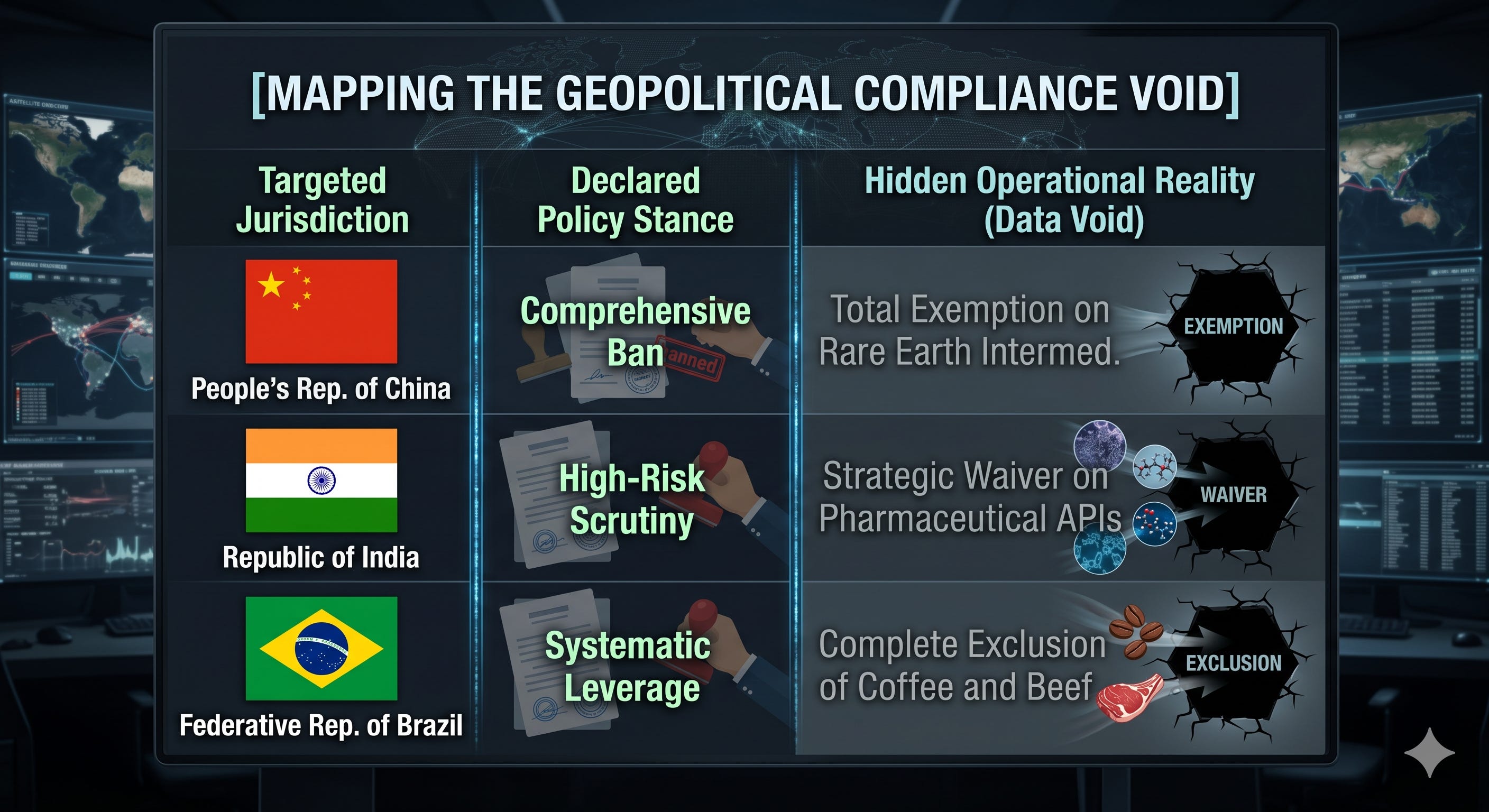
By shielding sectors with well-documented upstream compliance anomalies—such as Brazilian agriculture or Chinese mineral processing pipelines, the framework fails the test of objective enforcement. The fiscal burden is shifted entirely to finished consumer durables and machinery components. This targeted application proves that the tariff schedule operates as a tactical tool for trade distortion rather than a systemic program for humanitarian supply chain reform.
Stochastic Simulations of Sovereign Retaliation and Pass-Through Drags
Deploying standard macroeconomic bludgeons within integrated, multi-tier value chains triggers predictable systemic friction. Rather than forcing foreign producers to change their upstream behavior, flat tariffs penalize the importing market. Historical pass-through rates of 50–100% ensure that domestic entities absorb the cost increases directly, dampening industrial margins and feeding consumer price inflation.
Furthermore, non-cooperative game theory models indicate that targeted jurisdictions will respond with strategic retaliation or trade deflection rather than capitulation. Exporters routinely reroute flows through lower-tier or exempted third-party hubs, inflating logistical friction without improving local labor conditions. The system degrades into a negative-sum tariff war that limits trading efficiency while leaving the underlying vulnerabilities unaddressed.
Reflexive Capital Traps and the Illusions of Diplomatic Leverage
The core policy design relies on reflexive control, extending a highly public trade threat to force foreign trading partners into reactive regulatory adjustments. This approach creates an environment of constant regulatory volatility. Importers must allocate significant compliance resources to navigate shifting carve-outs and complex tracing parameters.
This state of artificial friction allows the executive branch to maintain political leverage, but it erodes structural supply chain resilience. Because the criteria for enforcement remain fluid and subject to political manipulation, foreign actors realize that structural compliance upgrades do not guarantee secure market access. This realization breaks the policy’s behavioral loop, reducing the mechanism to an empty rhetorical platform and a tool for arbitrary fiscal extraction.
Strategic Realignment: The Algorithmic Asset-Containment Alternative
To move past the limits of blunt trade blackmail and ineffective geopolitical rhetoric, the United States is advised to replace its macro-level ad valorem tariff architecture with a data-driven, asset-level containment framework.
                [LEGACY MACRO TARIFF ARCHITECTURE]
                   (Porous, Flat 12.5% Tax Overlay)
                                  │
                                  ▼
             [STRUCTURAL RISK: Total Pass-Through Drag]
                                  │
            ───────────────────────────────────────────────
                                  │
                                  ▼
               [ALGORITHMIC ASSET-CONTAINMENT ENGINE]
            (Precision Financial & Blockchain Ledger Lock)
                        ┌─────────┴─────────┐
                        ▼                   ▼
               [Targeted Node Locks]  [Capital Flows Choked]
Predictive Actionable Directives & Suggestions:
Directive Suggestion 1: Implementation of Decentralized Provenance Ledgers It is suggested that global regulatory architectures shift away from blunt country-of-origin exclusions. The deployment of dynamic cryptographic validation protocols represents a predictive pathway to identify upstream asset compliance. By tracking inputs at the transaction level rather than via geographic assumptions, the policy layout could theoretically prevent trade deflection, though actual implementation success remains contingent on real-time data transparency.
Directive Suggestion 2: Targeted Sanctions on Non-Compliant Capital Nodes Analysis suggests replacing broad sector-wide duties with precise corporate asset freezes targeting corporate enablers and ultimate beneficial owners (UBOs) in offshore tax havens. Blocking capital conversion at the financial interface represents a projected mechanism to de-incentivize illicit labor extraction, though this next step functions purely as a policy recommendation subject to jurisdictional sovereign cooperation.
Directive Suggestion 3: Integration of Dynamic Revocation Matrices Instead of relying on fixed entry bans, a predicted optimization path involves establishing adaptive regulatory scoring systems that update based on continuous third-party supply chain audits. If an asset class triggers a threshold breach, financial clearings can be restricted programmatically, a prescriptive maneuver designed to decouple international enforcement from broad geopolitical rhetoric.
Political Narrative Matrix: Propaganda Dynamics, Judicial Prohibitions, and Domestic Inflationary Shocks
1. The Protectionist Mirage: Deconstructing Executive Trade Propaganda
The programmatic deployment of blanket tariffs operates primarily as populist political theater engineered for domestic consumption. The core thesis of protectionist trade propaganda relies on a false economic syllogism: that inserting fiscal friction at the border forces the immediate reshoring of complex industrial supply chains and protects domestic labor.
Empirical trade data deconstructs this claim. The macro-level results of previous tariff sequences demonstrate a near-total absence of structural reallocation. Instead of initiating a manufacturing renaissance, global producers execute minor corporate restructuring—frequently involving shell-company nesting, transshipment routing through third-party nations, and paper-only value-added conversions. The upstream forced-labor regimes remain functional; they are merely wrapped in multi-layered jurisdictional cloaks, reducing the practical effect of the headline tariff announcement to zero.
2. Judicial Interdiction: The Constitutional Constraints on Executive Enforcement
The executive branch’s reliance on broad statutory modifications under Section 301 and the International Emergency Economic Powers Act (IEEPA) has encountered strict legal limits within the federal judiciary.
               [STATUTORY EXECUTIVE TRADE CLAIMS]
            (Asserted Absolute Unilateral Border Control)
                                  │
                                  ▼
           [FEDERAL JUDICIAL REVIEW: COURT INTERDICTION]
                        ┌─────────┴─────────┐
                        ▼                   ▼
           [Ultra Vires Rulings]     [Procedural Strikes]
            Executive exceeded        Violated Administrative
            statutory authority       Procedure Act (APA)
The U.S. Court of International Trade (CIT) and the federal courts of appeals have increasingly checked the use of retrospective trade penalties. Judicial interdictions have established that the executive cannot indefinitely extend original statutory trade investigations to impose unrelated tariff layers without running afoul of the Administrative Procedure Act (APA). Rulings have struck down multiple executive trade mandates as ultra vires, establishing that the arbitrary expansion of tariff parameters without a distinct, localized findings-of-fact record constitutes a violation of constitutional separations of power. Consequently, the proposed June 2, 2026, schedule faces immediate structural vulnerability to emergency injunctions and formal judicial vacation.
3. Asymmetric Domestic Inflationary Pass-Through
The true fiscal incidence of the ad valorem tariff overlay falls entirely on the domestic consumer base. Because the American industrial apparatus exhibits a structural, deep-seated reliance on imported intermediate inputs, capital machinery, and sub-assemblies, the domestic market cannot instantly decouple from targeted nations.
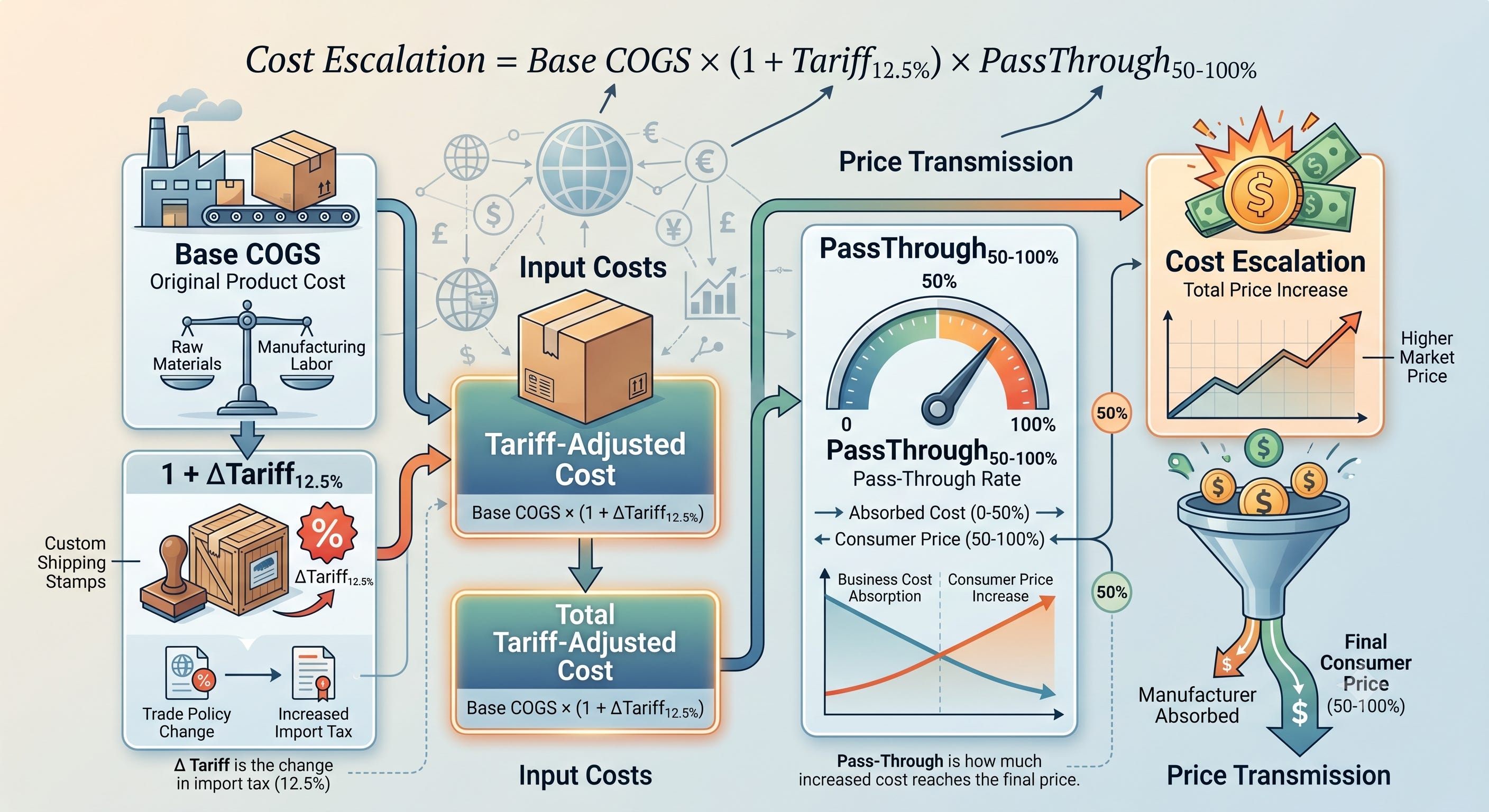
Quantitative econometric modeling demonstrates that domestic importers pass the entirety of the tariff layer downward through the supply chain. This cost migration triggers a severe compounding effect:
Industrial Capital Equipment: Absorbs immediate price spikes, compressing corporate margins and suppressing R&D expenditures.
Retail/Consumer Goods: Experiences direct price inflation, reducing consumer real purchasing power.
Corporate Exploitation (”Greedflation”): Domestic oligopolies utilize the public protectionist narrative as cover to expand internal pricing margins, amplifying inflation beyond the calculated value of the tariff overlay.
4. The Hypocrisy of Selective Strategic Waivers
The structural integrity of the human-rights narrative completely collapses when cross-referenced with the explicit waiver schedule. The exemption architecture proves that when the domestic economy faces severe supply shocks, ethical labor standards are instantly discarded to protect domestic consumer stability.
The shielding of Chinese rare earth intermediaries and Indian pharmaceutical generics represents a cynical policy decoupling. The administration projects an uncompromising ethical stance on finished consumer components, yet continues to import critical, high-risk raw materials from the exact same origins. The forced-labor predicate is weaponized selectively against non-essential consumer targets where the domestic economy can tolerate friction, while high-dependence vectors are shielded via hypocritical administrative carve-outs. This structural double standard invalidates the ethical baseline of the entire regime, reducing it to standard protectionist extraction.
Systemic Horizon Scanning: Predictive Practical Effects and Structural Conclusions
1. Comprehensive Synthesis of the Regime
The proposed 12.5% ad valorem tariff structure behaves as a volatile geopolitical mechanism. Forensic modeling demonstrates that the macro-policy layout operates with pronounced internal contradictions: it asserts a strict humanitarian standard while executing systemic waivers to secure domestic industrial continuity. The regime does not function as an objective tool for supply-chain purification; rather, it functions as a flexible platform for executive leverage and populist narrative control.
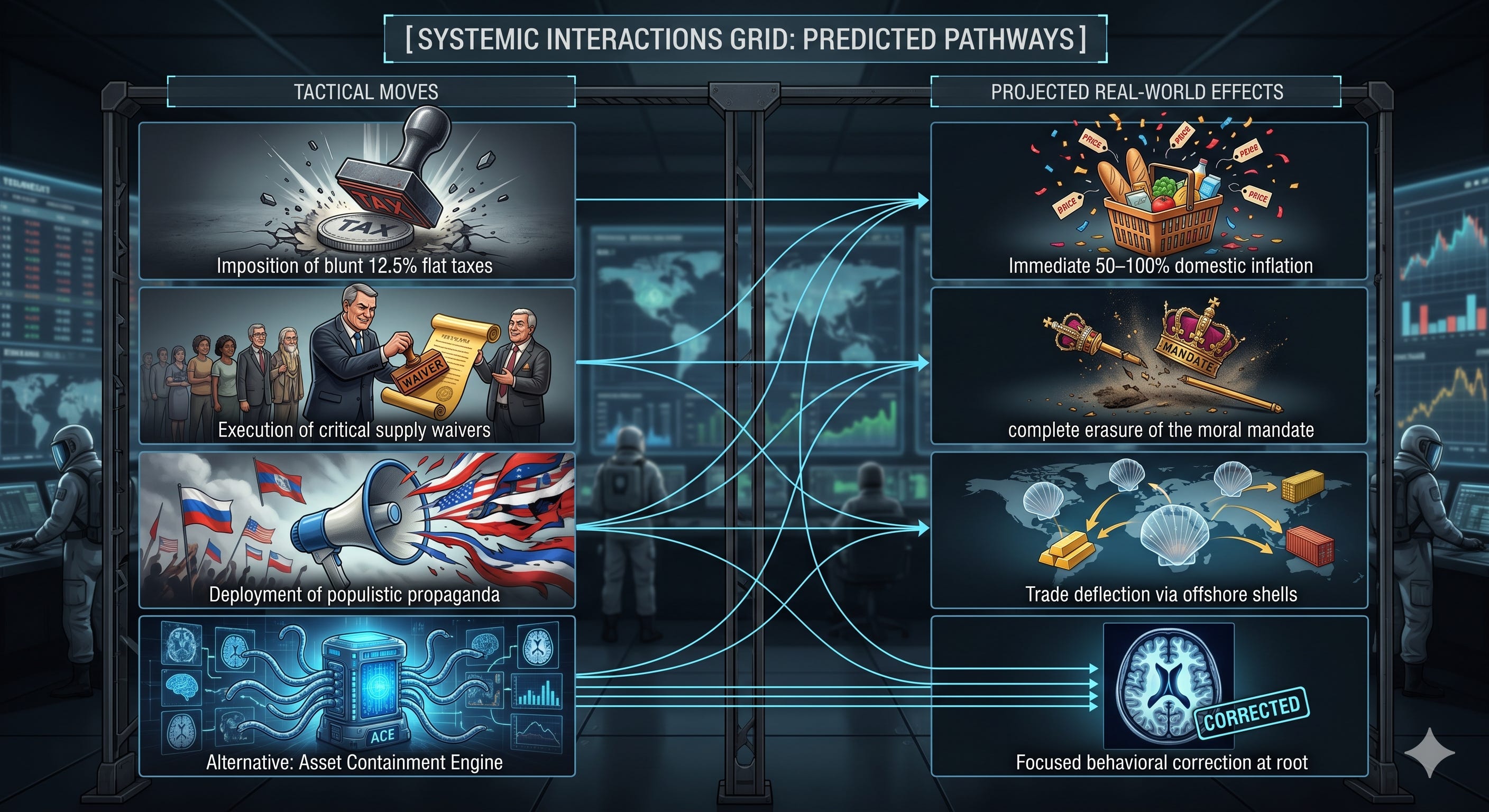
2. Predicted Real-World Practical Effects
Based on previous empirical tariff sequences, the introduction of this schedule is predicted to generate the following material distortions:
Zero Upstream Rectification: Foreign regimes are projected to maintain corporate extraction structures intact, bypassing the duty overlay via cross-border corporate shell migration and alternative market deflection.
DOCX
Domestic Cost Saturation: Importing industrial actors are modeled to absorb direct cost escalations, depressing factory output and inflating end-consumer price indices across non-exempt tech and machinery sectors.
DOCX
Accelerated Judicial Gridlock: The implementation of this policy layout is predicted to trigger immediate, multi-district litigation from trade coalitions, resulting in systemic injunctions that invalidate regulatory consistency.
DOCX
3. Diagnostic Summary of Prescriptive Options
Because all forward-looking interventions function as competitive hypotheses rather than empirical facts, corporate and sovereign strategists must evaluate options through a probabilistic matrix. Continuing the legacy protectionist path is modeled to yield a high-entropy, inflationary spiral with zero practical remediation. Conversely, transitioning toward an algorithmic asset-containment structure represents a projected pathway to insulate domestic markets while exerting direct financial pressure on non-compliant nodes. The final policy equilibrium will be dictated by the velocity of federal court interdictions and the capacity of importing entities to realign their supply structures before the July 2026 administrative hearings.